
A Loyola Law School librarian on the two questions she hears most at the start of every semester
Law students don’t know what they don’t know. Librarians do. They hear the same questions at the reference desk every semester, watch the same research mistakes repeat every fall, and know which shortcuts practicing attorneys actually use. Most of that knowledge never makes it to students until they think to ask.
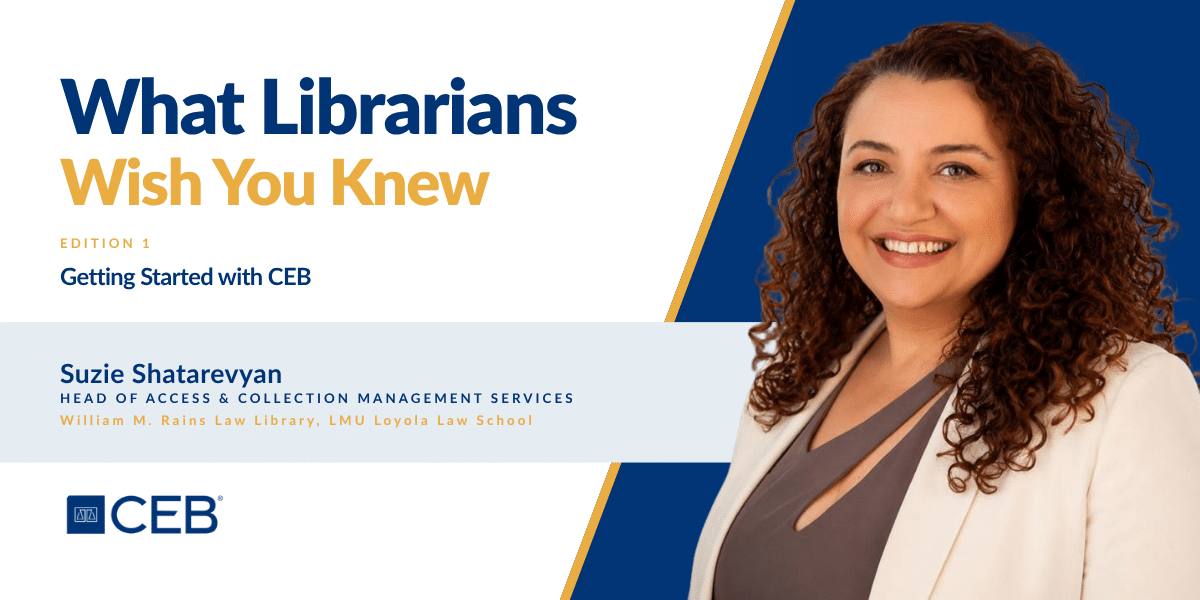
What Librarians Wish You Knew is a new series that closes that gap. Each month, a California law librarian shares the insider knowledge they wish every student had before walking up to the desk. First up is Suzie Shatarevyan, Head of Access & Collection Management Services at the William M. Rains Law Library at LMU Loyola Law School. Her first topic is the one that comes up most in August and January: getting access to CEB and knowing what to do once you have it.
First, get your account. It’s free, and it outlasts law school.
Many students don’t realize they already qualify for CEB. Through the AccessLaw Program, CEB provides California-specific legal research accounts at no cost to students at ABA-accredited law schools.
“CEB materials are exceptionally powerful for law students because they bridge the gap between theoretical law school concepts and practical, real-world application,” Suzie says. “Your library can help you set up access with a law school code.”
The detail students most often miss is the timing. CEB continues to provide 18 months of free access after graduation, which carries you through bar prep and into your first year of practice. The catch is that you must register while you are still a student. Once you graduate, update your account with a personal or new professional email so your access follows you out the door.
Suzie’s advice is simple: contact your law librarian and request access. It takes a few minutes and the account is yours through the start of your career.
You have your code. Now what?
Your librarian has given you an access code. The next step is to activate your account at research.ceb.com/register/academic.
Once you log in, you’ll see a dashboard with three areas: Favorites, History, and a News Feed. Favorites and the News Feed are customizable, so you can set preferences for the practice areas you care about and get to them in one click instead of searching every time.
From there, Suzie recommends taking a minute to learn how the content is organized. The tabs at the top of the page lead you to practice areas, secondary sources, California Codes, and the Rules of Court. The practitioner materials are where most students find the real value: step-by-step how-to guides, workflows, checklists, and ready-to-use sample forms.
“Over 1,400 active California attorneys and judges help create CEB materials, and these are the same materials that many California attorneys use in their own practice,” Suzie says. “As a law student, access these resources to prepare to practice.”
That is the point of the account. Law school teaches you how the law works. CEB shows you what it looks like when attorneys actually use it: the motion, the checklist, the form, the local rule. Having both before you graduate is an advantage most of your future colleagues didn’t have.
Your next step
- Ask your law librarian for your school’s AccessLaw code.
- Already have a code? Activate your account at research.ceb.com/register/academic.
- Graduating soon? Update your account email before you lose access to your school address.
About Suzie Shatarevyan
Suzie Shatarevyan is an academic law librarian who serves as Head of Access & Collection Management Services at the William M. Rains Law Library at LMU Loyola Law School. She holds a Bachelor of Arts from UC Santa Barbara and a Master of Library and Information Science (MLIS) from San Jose State University. Beyond her role, she is active in the campus community, serving as Co-Chair of Governance for the LLS Staff Senate and as a longtime IT Chair for the Southern California Association of Law Libraries.
Connect with Suzie on LinkedIn: linkedin.com/in/suzieshatarevyan
LMU Loyola Law School: linkedin.com/school/loyola-law-school